The final week of February ended with a clear divergence between relatively calm FX trading and strong moves in commodities and crypto. The market went into the weekend with heightened geopolitical anxiety, and the start of military action against Iran on Saturday, 28 February 2026 sharply raised the probability of a risk-off opening for Monday. This matters first of all for energy and safe-havens: oil typically prices supply-disruption risk immediately, while gold and silver tend to attract defensive flows. At the same time, the dollar often benefits as a liquidity and safety bid, which can cap EUR/USD rebounds even when the euro itself is not under direct pressure. Crypto may remain highly reactive, with abrupt intraday swings and fast sentiment shifts if headlines intensify.
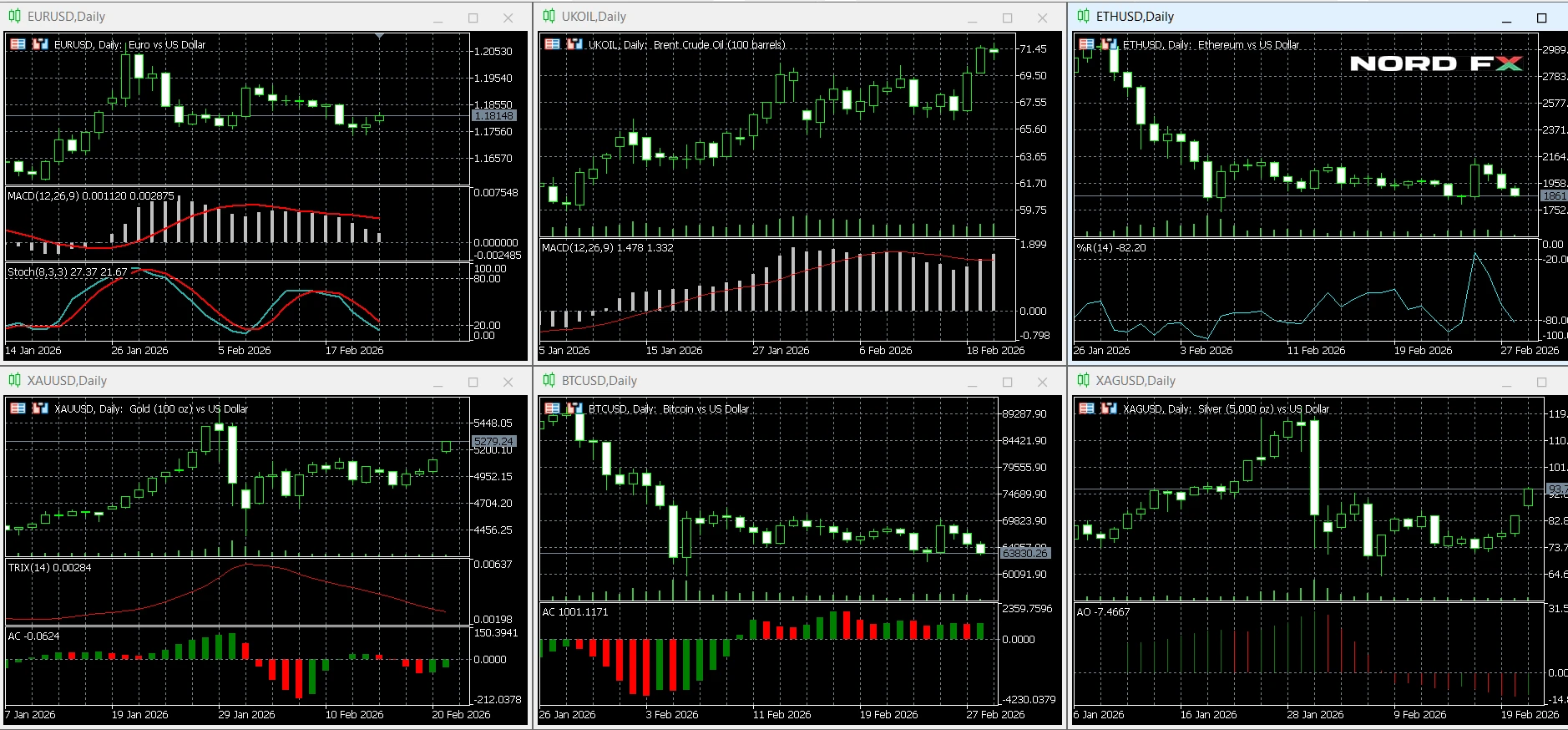
As of the close on Friday, 27 February 2026, EUR/USD finished near 1.1815, Brent (UKOIL) closed near 71.45, gold (XAU/USD) closed near 5,279.24, silver (XAG/USD) ended near 93.7, bitcoin (BTC/USD) closed near 64,830, and Ethereum (ETH/USD) closed near 1,861. With weekend escalation now in play, traders should be prepared for gaps at Monday’s open and for levels to be tested faster than usual.
EUR/USD
EUR/USD remains in a consolidation corridor around the 1.18 area, but the weekend shock increases the odds of renewed USD demand at the start of the week. In that scenario, rebounds can be sold sooner, and support levels may be tested more aggressively than they were during February’s range trading.
The nearest resistance area is 1.1860-1.1900. A sustained break above 1.1900 would shift focus toward 1.1960-1.2030, but this requires a quick reduction of risk-off pressure. Support sits at 1.1760-1.1740; a confident move below 1.1740 would open the way toward 1.1680-1.1650.
Baseline view: neutral-to-bearish while EUR/USD remains below 1.1860, with risks skewed toward a test of 1.1760-1.1740 if the dollar strengthens on safe-haven flows.
Brent Crude Oil
Brent closed near 71.45, and the new geopolitical backdrop makes oil the most sensitive instrument in this set. The key change versus last week is that the risk premium is no longer hypothetical, so any sign of escalation or supply-route disruption can trigger a sharp spike and potentially a gap higher on Monday.
If Brent holds above 71.10-71.80, a move toward 73.50-75.00 becomes the primary scenario. A break and consolidation above 75.00 would open the way toward 76.50-78.00, and in a headline-driven environment even higher extensions cannot be excluded. If price fails to hold 71.10, a pullback toward 70.00-69.00 remains possible, but for now that looks like a secondary scenario unless tensions ease quickly.
Baseline view: bullish, with the market biased toward 73.50-75.00 while Brent stays above 71.10-71.80.
Gold (XAU/USD)
Gold ended the week near 5,279.24 and remains one of the clearest beneficiaries of risk-off flows. The weekend escalation increases the probability that buyers will defend pullbacks quickly, even if short-term technical indicators look stretched.
Support is expected in the 5,220-5,180 zone. A rebound from this area keeps the path open toward 5,300-5,350. A breakout above 5,350 would open the way toward 5,420-5,500, especially if uncertainty remains elevated. A sustained move below 5,180 would signal a deeper correction toward 5,080.
Baseline view: bullish, with a preference to buy dips while gold holds above 5,180.
Silver (XAG/USD)
Silver closed near 93.7 and remains highly volatile. In a geopolitical shock, silver can follow gold higher, but swings can be sharper and pullbacks deeper, so risk control matters more than usual.
Support lies at 91.00-88.50. Holding above this zone keeps the bullish scenario active, with targets at 95.00-98.00. A breakout above 98.00 would open the way toward 100.00-103.00. A sustained break below 88.50 would shift the balance toward 86.30-84.60.
Baseline view: cautiously bullish while silver remains above 88.50, with elevated volatility expected.
Bitcoin (BTC/USD)
bitcoin closed near 64,830 and remains technically fragile. In a classic risk-off impulse, crypto can come under pressure together with equities, yet it can also bounce sharply if liquidity returns or if markets start treating it as an alternative hedge. With headlines likely to dominate early week trading, direction may be driven less by fundamentals and more by positioning and volatility dynamics.
Resistance is located at 69,000-71,000; a breakout and consolidation above this area would open the way toward 73,000-77,000. On the downside, a slide toward 65,000-64,000 keeps the risk of deeper support tests near 62,500-60,000.
Baseline view: neutral-to-bearish while bitcoin remains below 69,000, with downside risk elevated if risk-off sentiment intensifies.
Ethereum (ETH/USD)
Ethereum closed near 1,861, staying below the key psychological 2,000 level. Like bitcoin, ETH is likely to react to the tone of global risk sentiment and liquidity conditions, with abrupt swings possible if weekend news triggers broader market repricing.
Support at 1,900-1,850 is now the key zone, and a break below 1,850 would open the way toward 1,750. If ETH can regain 1,950-2,020, a rebound toward 2,080-2,150 becomes possible, and a move above 2,150 would open the path toward 2,250-2,400.
Baseline view: neutral, with a defensive bias while ETH trades below 2,020 and remains vulnerable under 1,900.
Summary
The main adjustment for March 02-06 is that markets are no longer trading only macro data and technicals; they are also pricing an active geopolitical shock. Brent and gold are the most direct beneficiaries, with silver likely to follow but with sharper volatility. EUR/USD may lean lower if safe-haven dollar demand strengthens. Crypto remains highly reactive and may experience fast moves in both directions, but until key resistance zones break, the baseline for bitcoin and Ethereum stays cautious.
NordFX Analytical Group
Disclaimer: These materials are not an investment recommendation or a guide for working on financial markets and are for informational purposes only. Trading on financial markets is risky and can lead to a complete loss of deposited funds.