Most people want the same financial outcome: more freedom, more stability, and more control over how they earn money. Yet the route to that outcome can look very different depending on whether income is active, passive, or a combination of both.
The difference between active and passive income is often presented too simply. In popular discussions, active income is described as money you “work for”, while passive income is money that “works for you”. That sounds neat, but real life is more nuanced. In practice, active income usually demands your ongoing time and direct effort, whereas passive income is typically built from assets, systems, or investments that can continue generating returns with less day-to-day involvement. The key phrase here is less involvement, not no involvement. Truly effortless income is rare.
Understanding the difference between active and passive income matters because it shapes how you plan your career, manage your savings, and think about long-term wealth. It also affects how much risk you take, how dependent you are on your personal labour, and how resilient your finances remain if your circumstances change.
What is active income?
Active income is money earned in exchange for direct work. If you stop performing the work, the income usually slows down or stops as well. Salaries, wages, freelance fees, consulting revenue, commissions, and many service-based business earnings all fall into this category.
For most people, active income is the foundation of financial life. It pays rent or a mortgage, covers food and bills, funds emergency savings, and often provides the capital used later to build investments. Even many successful investors and entrepreneurs began with active income before expanding into other sources of earnings.
The biggest advantage of active income is clarity. You know where it comes from, what actions produce it, and how often it arrives. In many cases, it is also the fastest way to start earning. You do not usually need large starting capital to get paid for a job, a skill, or a service.
However, active income has an obvious limitation: it is closely tied to your time, energy, and availability. There are only so many hours in a day, and there is often a ceiling on how much one person can earn without raising prices, improving skills, changing roles, or scaling into a business. This is why many people eventually start looking for ways to complement active income with more scalable sources.
What is passive income?

Passive income is income generated by assets or systems that do not require the same continuous, hands-on effort as a traditional job. Common examples include dividend-paying shares, interest from savings or bonds, rental income, royalties, affiliate revenue, or income from digital products created in advance.
That said, passive income is often misunderstood. A buy-to-let property still needs management. A dividend portfolio still requires research and risk control. A blog or online course may take months of active work before it produces recurring revenue. In other words, passive income is frequently front-loaded: you invest time, money, or both at the beginning, and only later benefit from a more automated flow.
This distinction is important because it prevents unrealistic expectations. Passive income is not a magic button. It is usually the result of one of three things: accumulated capital, accumulated expertise, or accumulated systems.
The core difference between active and passive income
The clearest difference between active and passive income lies in the relationship between time and earnings.
With active income, your earning power is usually connected to hours worked, tasks completed, or your direct presence in the process. With passive income, earnings are more closely connected to the performance of an asset, business model, or investment structure.
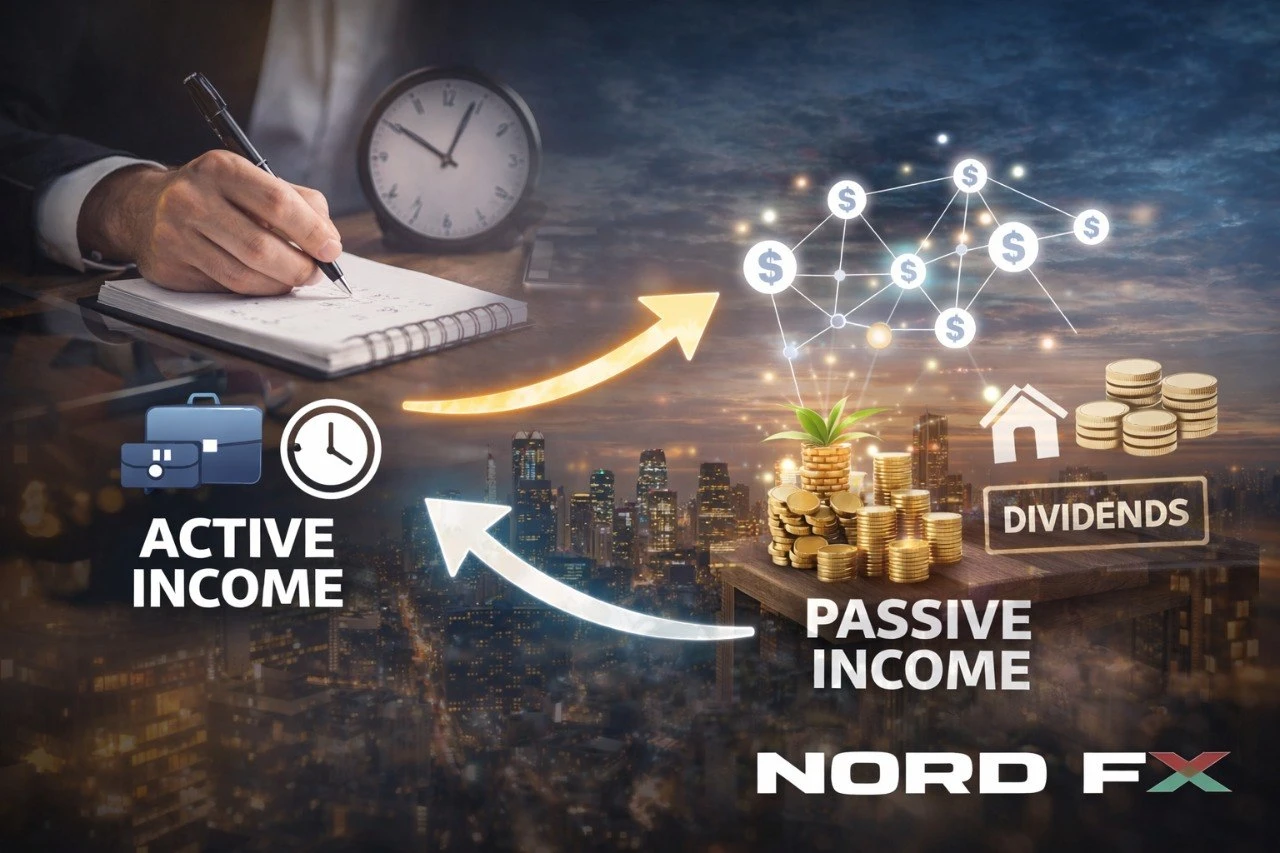
Another major difference is scalability. Active income can grow, sometimes significantly, but often through more effort, better skills, or greater responsibility. Passive income has the potential to scale more efficiently because an asset can continue to generate returns without the same one-to-one link between effort and reward.
There is also a difference in timing. Active income is usually immediate or short-cycle: you work this month and get paid this month. Passive income often involves delay: you save, invest, build, publish, or acquire first, and only then begin to receive returns.
Finally, there is a psychological difference. Active income feels tangible because you can directly see the cause and effect. Passive income can feel slower and less certain at first, but over time it may provide more flexibility and financial resilience.
Why active income is still essential
Because passive income gets so much attention online, people sometimes underestimate the importance of active income. This is a mistake.
In most cases, active income is what allows passive income to exist later. It gives you the funds to invest, the skills to build products, and the discipline to create a financial base. Without active income, many people would struggle to accumulate the capital needed for dividends, property, interest-bearing instruments, or trading accounts.
Active income also tends to be more predictable in the early stages of life or business. If someone is just beginning their financial journey, building reliable earned income is usually the first priority. That may mean improving qualifications, developing a specialist skill, creating a side service, or increasing earnings through more valuable work.
This is where education and practical market knowledge become useful. For readers who want to understand the broader financial environment before moving beyond earned income, the NordFX Useful Articles section offers a range of introductory and intermediate materials on trading, markets, and financial decision-making.
Why passive income attracts so much interest
The appeal of passive income is easy to understand. It promises leverage. Instead of earning only when you are actively working, you create a structure that may continue producing cash flow even while you sleep, travel, or focus on other projects.
Passive income also diversifies financial risk. If a person depends on a single salary and that salary disappears, the financial shock can be severe. If income comes from several sources, the overall picture may be more stable. This is one reason why many people aim to combine a primary job with investments or side assets over time.
For market-focused individuals, passive-style income can take many forms. It may involve dividend strategies, interest-bearing products, long-term portfolio holdings, or systematic approaches to managing capital. Those who want to learn more about the practical side of entering financial markets can review NordFX’s Getting Started section, which explains the basic route from registration to first market activity.
Can trading be active or passive income?
This is where the subject becomes especially interesting. Trading can sit in either category depending on how it is approached.
If someone manually analyses charts, reacts to news, places trades personally, and manages positions throughout the day, trading is closer to active income. It requires ongoing attention, decision-making, and time. Results depend heavily on the trader’s direct actions.
But if trading is part of a broader capital-allocation framework, or if it uses more systematic methods, it can move somewhat towards the passive side, though rarely becoming fully passive. The same applies to investing. A long-term investor may spend relatively little time on day-to-day management compared with a short-term trader, yet the income is still dependent on research, market conditions, and risk tolerance.
For this reason, it is more accurate to think of active and passive income as a spectrum, not a rigid binary. Some income streams are fully active. Some are relatively passive. Many sit somewhere in the middle.
Readers exploring how market participation works in practice can compare available account structures on NordFX’s Trading Accounts page and review the broker’s Trading Platforms section, which covers MT4 and MT5 access across different instruments.
Which is better: active income or passive income?
Neither is universally better. They serve different purposes.
Active income is usually better for starting, learning, and maintaining day-to-day financial security. It gives structure, cash flow, and immediate earning capacity.
Passive income is usually better for scaling, diversifying, and reducing dependence on constant labour. It can strengthen long-term wealth building and create more flexibility.
The strongest financial strategy often combines both. Active income covers present needs and helps build capital. Passive income, developed gradually and realistically, can improve future stability and optionality.
A person with only active income may remain trapped in a time-for-money cycle. A person who chases passive income without a stable base may take unnecessary risks or fall for unrealistic promises. The balance is what matters.
Common mistakes people make
One common mistake is assuming passive income requires no work. In reality, most passive income involves effort, capital, patience, or all three.
Another mistake is dismissing active income as inferior. For many people, their profession, expertise, or business activity is their most valuable asset. It can generate high earnings, teach discipline, and fund future investments.
A third mistake is trying to build passive income too quickly through products or schemes they do not fully understand. Whether it is property, stocks, crypto, or trading, the principle is the same: do not confuse complexity with opportunity. The better path is usually steady learning, realistic expectations, and clear risk management.

Final thoughts
The difference between active and passive income is not just a technical definition. It is one of the most useful frameworks for thinking about personal finance and wealth creation.
Active income buys time, experience, and starting capital. Passive income can gradually buy flexibility, diversification, and greater financial independence. One is not the enemy of the other. In most successful financial lives, they work together.
The real goal is not to choose one side blindly. It is to understand where your money comes from today, where you want it to come from tomorrow, and what steps can realistically take you from one stage to the next. Once you view income that way, the conversation becomes less about online slogans and more about building a durable financial structure that matches your goals, skills, and risk tolerance.
For readers who want to keep developing their market knowledge, following current analysis in NordFX Market News can also help connect broad financial concepts with real market behaviour.
Go Back Go Back